- Football Gist
- Posts
- Rules of Football:- A complete Beginner's Guide
Rules of Football:- A complete Beginner's Guide

Yashraj Kumar
January 24, 2025
Football is one of the world’s most popular sport, loved by millions of people across countries, cultures, and generations. Watching your heroes like Lionel Messi, Cristiano Ronaldo, or Different matches of FIFA World cup, La Liga, Premier League etc. is so amazing and fun to watch. But sometimes, a referee's decision a sudden whistle, a card flashed, or a goal disallowed for offside can shock you or you may scratches your head. and you might "Why did they blow the whistle for a 'handball' when it clearly hit the player's chest?" or " Why that player receive the Red card?"
The entire sport is governed by a set of universal guidelines called the Laws of the Game, Created by International Football Association Board (IFAB).
This detailed, guide will break down all the major
Laws into simple section for better understanding of these laws
The Football Field and Its Dimensions
The match is played on a rectangular field known as the pitch. The length is between 90-120 metres (100-130 yards), Width is between 45-90 metres (50-100 yards). The Dimension of international matches or league are between 100-110 meters length and 64-75 meters width. With Each goal is 8 yards (7.32 m) wide and 8 feet (2.44 m) high. And a net is attached to catch the ball. In Football field there is Penalty box:- The large box around the goal, Goal area:- Smaller box inside the penalty area, Center circle:- Used during kick-off, Corner arcs:- Used during corner kicks.
Number of Players and Substitutions
A football match is played between two teams of 11 players each, including:-1 Goalkeeper and 10 Outfield Players (defenders, midfielders, forwards). A match cannot start or continue if a team has fewer than seven players.
Substitution
A team is typically allowed up to five substitutions per match to replace the player who is playing. Substitutes can only enter the field after the player they are replacing has left, and they must enter at the halfway line. and the player who has been substituted cannot return to the match for playing. One team have only 3 opportunities (plus half-time) to make these changes to prevent time-wasting.
Match Duration and Stoppage Time
A standard football match lasts 90 minutes, divided into two equal half of 45 minutes each. And Unlike some sports, the clock does not stop when the ball goes out of play or for injuries. The referee keeps track of all the time lost and add stoppage time to compensate for interruptions at the end of each half this is typically called "stoppage" or "injury time". Knockout matches may have extra time (2×15 minutes) and penalties if the score is tied.
Starting and Restarting Play
Kick-Off Rules
A kick-off starts each half and after a goal is scored. The match begins with a kick-off from the center spot Opponents must stay outside the center circle until the ball is kicked. The ball is in play once it is kicked and clearly moves in any direction and one important things A goal can be scored directly from a kick-off.
How Goals Are Scored
A goal is awarded when the entire ball crosses the goal line between the posts and under the crossbar without a foul committed by the attacking team. A goal can be scored by Foot, Head, Chest, Shoulder, (but not with the arm or hand) A technology called "Goal Line Technology (GLT)" is used to know weather the ball crossed the goal line or not.
Throw In
When the ball completely crosses the touchline, a throw in is awarded to the opposing team of the player who last touched it. The thrower must face the field, have a part of both feet on the ground on or behind the touchline, and use both hands to throw the ball from behind and over their head.
Goal Kick
If the attacking team sends the ball over the defending team's goal line (without a goal being scored), the defending team gets a Goal Kick. The kick is taken from anywhere inside the Goal Area (6-yard box). And the opponents must remain outside the penalty area until the ball is in play (i.e., kicked and clearly moved).
Corner Kick
If the defending team sends the ball over their own goal line (without a goal being scored), the attacking team gets a Corner Kick. The kick is taken from the corner arc closest to where the ball went out. And a goal can be scored directly from a corner kick
Penalty Kick
A penalty kick is awarded when a foul occurs inside the penalty box. The Penalty Rules are very simple. The ball is placed on the Penalty Mark (11 metres from the goal). Only the kicker and the opposing goalkeeper are involved. All other players must remain outside the penalty area. The goalkeeper must have at least one part of one foot on or in line with the goal line when the kick is taken.
The Offside Rule Explanation
The offside rule is perhaps the most debated and difficult rule in football. it is about preventing "goal-hanging." A player is said to be offside position if:-
They are in the opponent's half of the field.
They are Closer to the opponents' goal line than both the ball and the second-last opponent (usually the last defender plus the goalkeeper)
Offside Exceptions: No Offside From... A player cannot be called offside if he receive the ball directly from a:-
Goal Kick
Throw-in
Corner Kick
Is Offside Offence a Foul
Being in an offside position is not a foul. A player is only penalised if, when the ball is played by a teammate, they become involved in active play by:- Interfering with Play- Touching or playing the ball passed by a teammate. Interfering with an Opponent- Blocking a defender's line of sight or challenging them for the ball. Gaining an Advantage- Playing the ball after it rebounds off the post, crossbar, or an opponent while they were in an offside position.
Fouls and Misconduct
Fouls are the illegal actions that disrupt the game unfairly. Misconduct refers to unsporting behaviour.
Fouls
A foul is committed when a player commits any of the following against an opponent in a manner considered "careless, reckless, or using excessive force":- Tripping, Kicking or attempting to kick, Pushing or charging, Jumping at, Striking or attempting to strike, Tackling (if the tackler makes contact with the opponent before the ball)
Handball
A handball is when a player (other than the goalkeeper in their own area) deliberately touches the ball with their hand or arm. Types of Handball Accidental handball- Usually not punished Deliberate handball- Always punished Handball leading to a goal- Disallowed
Yellow & Red Cards
Yellow Card (Caution)-A formal warning given for less serious misconduct, such as:- Unsporting behaviour (e.g., arguing with the referee).
Dissent (arguing/disagreeing with the referee's decision).
Persistent fouling.
Delaying the restart of play (time-wasting).
Entering or leaving the field without permission.
Red Card (Dismissal)- A player is immediately sent off the field and cannot be replaced, meaning their team must play with one less player. A red card is shown for serious offences, including:-
Serious Foul Play: Violence or aggression.
Violent Conduct: Striking an opponent, teammate, or official.
Using offensive or abusive language.
Denying a Goal or Obvious Goal-Scoring Opportunity
Receiving a second Yellow Card in the same match.
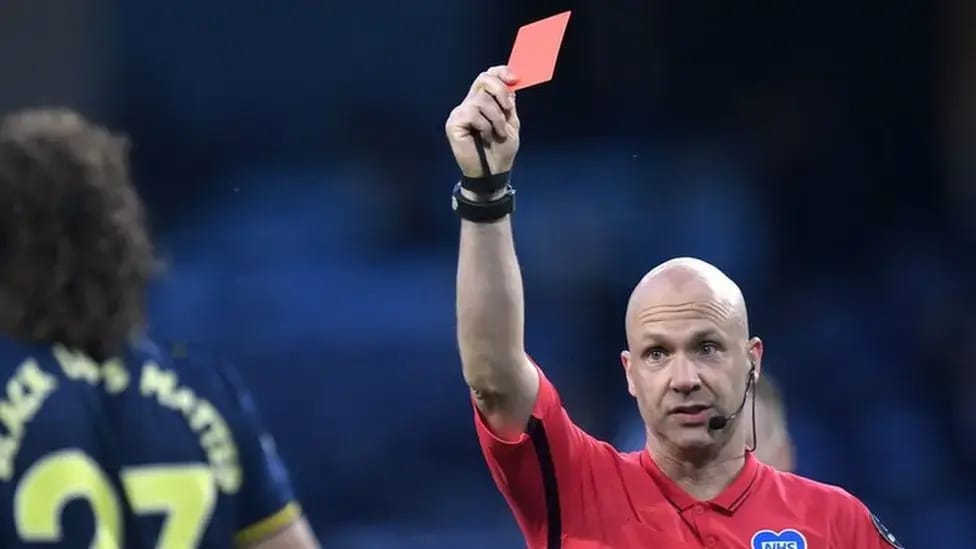
Courtesy-BBC; Referee showing red Card
The Officials: Referees and VAR
Referee Team Includes:-
Main referee
Two assistant referees
Fourth official
VAR team
VAR (Video Assistant Referee) Helps Check:-
Goals
Penalties
Direct red cards
Offside situations
VAR helps reduce major errors but the final decision always belongs to the on-field referee.
Conclusion
Football is simple to understand once we know
the basic rules. Whether we watching our's favourite club like Barcelona, Real Madrid Manchester City, or an ISL match, these rules help us to enjoy the game better. From kick-off to penalties, offside to VAR, every part of the game has a purpose - to make the sport fair, exciting, and enjoyable for everyone.
If you're new to football, keep watching matches and reading more guides on FootballGist.com - the more you learn, the more fun the game becomes.
Frequently Asked Questions (FAQs)
How many substitutions are allowed in football today?
Currently, in most top-level competitions like the FIFA World Cup and major leagues, teams are allowed a maximum of 5 substitutions. However, they only have 3 opportunities (plus the half-time break) to make these changes.
Why does the referee add extra time?
The clock in football never stops. The referee adds "stoppage time" at the end of each half to make up for time lost due to specific interruptions like injuries, substitutions, time-wasting, and goal celebrations
Can a goalkeeper pick up the ball from a pass by their own teammate?
No. If a teammate deliberately kicks the ball to the goalkeeper, the goalkeeper is not allowed to pick it up with their hands. This is known as the "back-pass rule." If they do, an indirect free kick is awarded to the opposing team.
What happens if a player gets a red card?
The player is immediately sent off the field and cannot be replaced. Their team must continue the match with one fewer player for the remainder of the game. and also suspended for next game but suspension may increase if the reason of red card is dangerous and officials want to increase the suspension.
How does VAR check for offside?
The Video Assistant Referee (VAR) uses calibrated cameras and software to draw virtual lines from the parts of the attacker's and defender's bodies that can legally score a goal. These lines determine who was closer to the goal line at the exact moment the pass was made