- Football Gist
- Posts
- How Teams Create Space in Football: Movement, Width, and Overloads
How Teams Create Space in Football: Movement, Width, and Overloads

Yashraj Kumar
March 29, 2025
In football, goals are the ultimate prize, but space is the currency needed to buy them. The primary challenge for any attacking team is to find and exploit areas on the pitch where they can advance the ball and create scoring chances. Successfully creating space is the foundation of all effective attacking play.
What Does Space Mean in Football?
Space simply means an area of the pitch where a player can receive the ball without immediate pressure. It can be wide, central, behind the defense, or between defensive lines. Good teams do not wait for space to appear they create it through movement and positioning.
Methods of Creating Space
1.Width (Using the Full Pitch)
What it means:- Positioning players as close to the sidelines (touchlines) as possible.
How teams use it:- Managers instruct wingers or fullbacks to stay wide rather than drifting into the middle.
Why it works:- It forces the opposing defenders to move further apart to cover the wide players. This creates larger "lanes" or gaps in the center of the pitch for midfielders to exploit.
Match Example:- Manchester City often keeps their wingers extremely wide to stretch the opponent's back four.
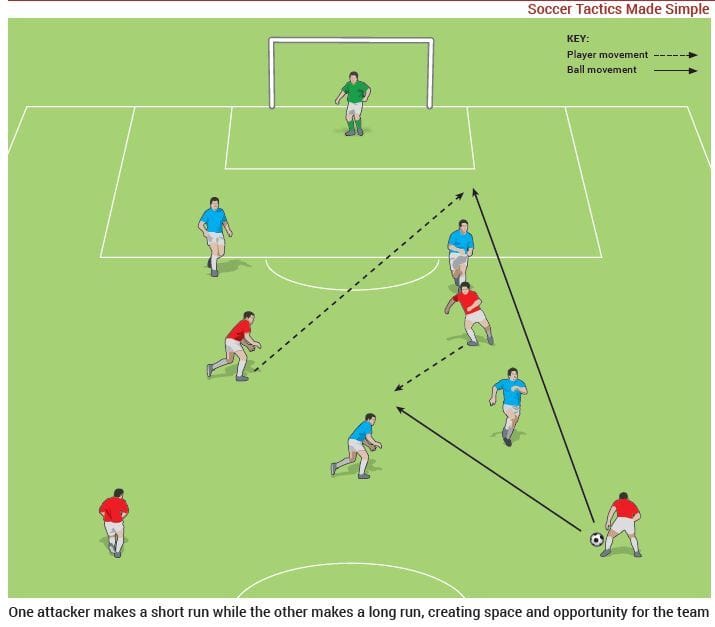
One player making the run and other passing the ball to him (Creating Space)
2.Depth (Stretching the Defense)
What it means:- Pushing the defensive line as close to their own goal as possible.
How teams use it:- A fast striker will constantly make runs toward the goal, even if they do not receive the ball.
Why it works:- Defenders are afraid of being outpaced, so they drop back toward their goal. This creates a large gap between the opponent's defenders and their midfielders, known as "playing between the lines."
Match Example:- Erling Haaland’s constant runs behind the defense force opponents to retreat, leaving room for playmakers like Kevin De Bruyne For Through Pass.
3.Off-the-ball Movement
What it means:- Players moving into new positions when they do not have the ball.
How teams use it:- A player might make a "decoy run," sprinting into a specific area just to drag a defender away from the ball carrier.
Why it works:- Defending is largely about concentration. When an attacker moves, the defender must decide whether to stay in position or follow the runner. Any hesitation creates a window of space.
Match Example:- A striker dropping deep into midfield to "pull" a center-back out of position, leaving a hole for a teammate to run into.
4.Overloads (Numerical Advantage)
What it means:- Creating a situation where the attacking team has more players in a specific zone than the defending team (e.g., a 2v1 or 3v2).
How teams use it:- A fullback will "overlap" their winger, running past them to create a two-on-one situation against the opposing defender.
Why it works:- A single defender cannot effectively mark two players at once. They must commit to one, inevitably leaving the other in open space.
Match Example:- Liverpool’s fullbacks frequently join the attack to create 3v2 situations on the flanks.
5.Positional Rotation
What it means:- Players fluidly swapping positions during a match.
How teams use it:- A left-winger may move to the center, while the striker moves to the left wing.
Why it works:- In many defensive systems, players are assigned to mark specific opponents or zones. Constant rotation causes confusion and "handoff" errors between defenders, leading to unmarked attackers.
Match Example:- The "Total Football" style or modern fluid front threes where players have no fixed positions.
How Defensive Shape Affects Space Creation
The way a team creates space depends on how the opponent defends. Against a high defensive line, teams use runs in behind. Against compact defenses, they rely on width, overloads, and quick movement. Good teams adjust their approach based on the opponent’s shape.
The Key to Breaking Low Blocks
A "low block" is a deep, compact defence. Creating space here is the ultimate test. The solution is a combination of the above methods: using extreme width to stretch the block horizontally, making decoy runs to pull defenders out, and creating quick overloads in wide areas to produce crossing opportunities before the defence can shift across.
Conclusion
When you understand how teams create space, football becomes easier to read. You notice movements, rotations, and patterns that lead to chances. For any fan, learning this concept turns matches into a tactical story rather than just a series of passes and shots.