- Football Gist
- Posts
- Different Football Formations Explained: A Beginner-Friendly Guide
Different Football Formations Explained: A Beginner-Friendly Guide

Yashraj Kumar
February 07, 2025

In modern football, a team’s success often depends on more than just the individual skill of its players. Tactics and structure play a massive role in how a match unfolds. At the heart of these tactics is the formation, it help teams balance attack and defense, control space, and respond to opponents. Understanding formations allows viewers to see why teams play the way they do and how tactics influence results.
What is a Football Formation?
A formation is described by a series of numbers that represent the distribution of players across the field, starting from the defense and moving toward the attack. For example, a 4-4-2 consists of four defenders, four midfielders, and two forwards. The goalkeeper is never included in these numbers, as their position is fixed. These numbers provide a general idea of a team's shape, but as we will see, these roles are often more fluid than they appear on paper.
Key Formations Broken Down
4-4-2 Formation
Basic Structure:- Four defenders, four midfielders (usually two central and two wide), and two strikers.
Strengths:- Balanced and compact. It provides two banks of four players that are difficult to break down defensively.
Weaknesses:- The two man midfield can easily be outnumbered by teams playing three or more central midfielders.
When it is used:- Often used by teams who want to remain disciplined and strike quickly on the counter attack.
Famous Examples:- Sir Alex Ferguson’s Manchester United, Diego Simeone’s Atlético Madrid.
Example Scenario:- When defending, the two lines of four stay compact, making it hard for opponents to break through the middle.
4-3-3 Formation
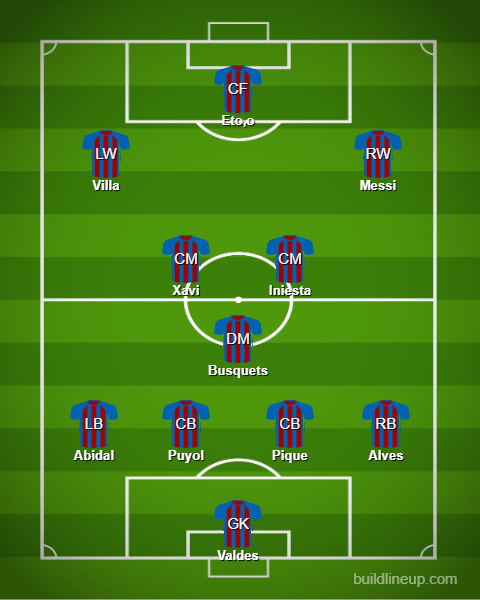
Barcelona Using 4-3-3
Basic Structure:- Four defenders, three central midfielders (often with one holder), and a front three of two wingers and a central striker.
Strengths:- Excellent for controlling the centre of the pitch and applying high pressure. The wingers provide width and direct attacking threat.
Weaknesses:- If the full-backs (the wide defenders) push too far forward to help the attack, they leave large gaps behind them for opponents to exploit.
When is it used:- By teams that want to dominate possession, press high up the pitch, and attack with width.
Famous Examples:- Pep Guardiola’s Barcelona and Jurgen Klopp’s Liverpool.
Example Scenario:- In attack, the two wingers move wide to stretch the defense, creating space in the center for the striker or oncoming midfielders.
4-2-3-1 Formation
Basic Structure:- Four defenders, two defensive midfielders (a "double pivot"), three attacking midfielders (usually one central, two wide), and a lone striker.
Strengths:- The two "holding" midfielders protect the defense, while the three attacking midfielders support a lone striker.
Weaknesses:- The lone striker can become isolated if the three attacking midfielders do not push forward quickly enough.
When is it used:- One of the most common modern formations, offering a strong blend of defensive security and attacking options through the three advanced midfielders.
Famous Examples:- Hansi Flick’s Bayern Munich or Jose Mourinho’s Real Madrid.
Example Scenario:- In defence, the two holding midfielders protect the central spaces, forcing opponents to play out wide where the team is more compact.
3-5-2 Formation
Basic Structure:- Three central defenders, five midfielders (including wing-backs who operate the entire flank), and two strikers.
Strengths:- Creates numerical superiority in central midfield. The wing-backs provide exclusive width, overloading the flanks in both attack and defence.
Weaknesses:- Heavily dependent on the fitness and quality of the wing-backs. The three defenders can be stretched by opposing teams with dangerous wide forwards.
When It Is Used:- When teams want defensive solidity with attacking support from wing-backs.
Famous Examples:- Antonio Conte’s Inter Milan or Juventus.
Example Scenario:- In attack, the wing-backs push high to become extra wingers, creating crossing opportunities for the two strikers in the box.
3-4-3 Formation
Basic Structure:- Three central defenders, four midfielders (often a flat or box-shaped central pair with two wing-backs), and a front three.
Strengths:- Extremely attacking and fluid. Provides multiple passing options and constant pressure with a high front line.
Weaknesses:- Can be vulnerable to counter-attacks, especially if the wing-backs are caught high up the pitch, leaving the three defenders exposed.
When It Is Used:- It is used by teams that want to attack aggressively and press high.
Famous Examples: Thomas Tuchel’s Chelsea or Antonio Conte’s Premier League winning Chelsea.
Example Scenario:- During attack, the front three press defenders, forcing quick mistakes.
How Formations Change During a Match ?
Formations are not fixed. A team may defend in a 4-4-2 shape but attack in a 2-3-5 shape as full-backs push forward. Coaches adjust formations based on scoreline, opposition, or game situation.
Formations Are Flexible, Not Rigid
Modern football focuses more on roles than exact positions. A full-back may act like a midfielder, and a forward may drop deep to create space. The listed formation is only a starting point.
Conclusion
Knowing football formations improves how we watch the game. You begin to notice tactical battles, player movements, and managerial decisions. For beginners and intermediate fans, understanding formations turns football from simple entertainment into a deeper and more enjoyable experience.